The Truth About Laser Hair Removal on Darker Skin Tones
Dr. S on 6/10/2026
Every week, young women and men walk into aesthetic clinic practices with patchy, dark burns across their upper lips, jawlines, or legs. They invested tens of thousands of rupees expecting smooth, hair-free skin, but instead left with post-inflammatory hyperpigmentation, which is just the medical term for those stubborn dark marks left behind after a skin injury. This happens because someone used a cheap, uncalibrated beauty salon laser machine that was never built to safely treat melanin-rich skin.
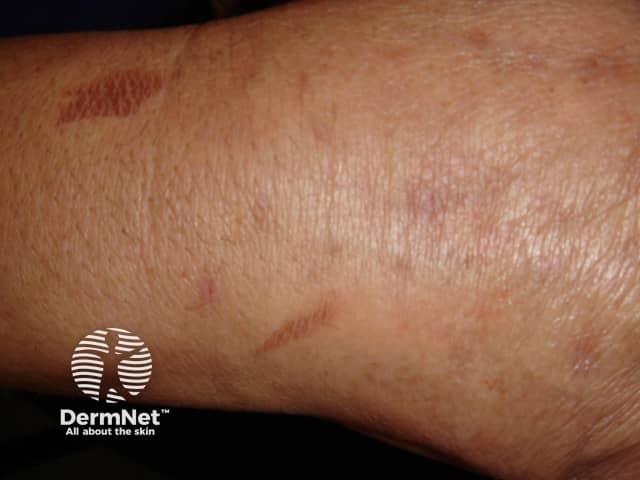
If you have a darker skin, you have likely been told that laser hair removal is either unsafe for you or that you should expect some blistering. That is a common misconception. This guide is for anyone with a melanin-dense skin in a tropical climate that will help you separate actual medical science from the deceptive marketing.
How laser removal work
To understand why lasers can go wrong, you have to understand how they work. Traditional laser hair removal operates on a principle called selective photothermolysis. This means the laser uses a specific wavelength of light to target a specific colored target, which in this case is the dark pigment inside your hair follicle. The light energy transforms into heat, destroying the follicle root so hair stops growing.
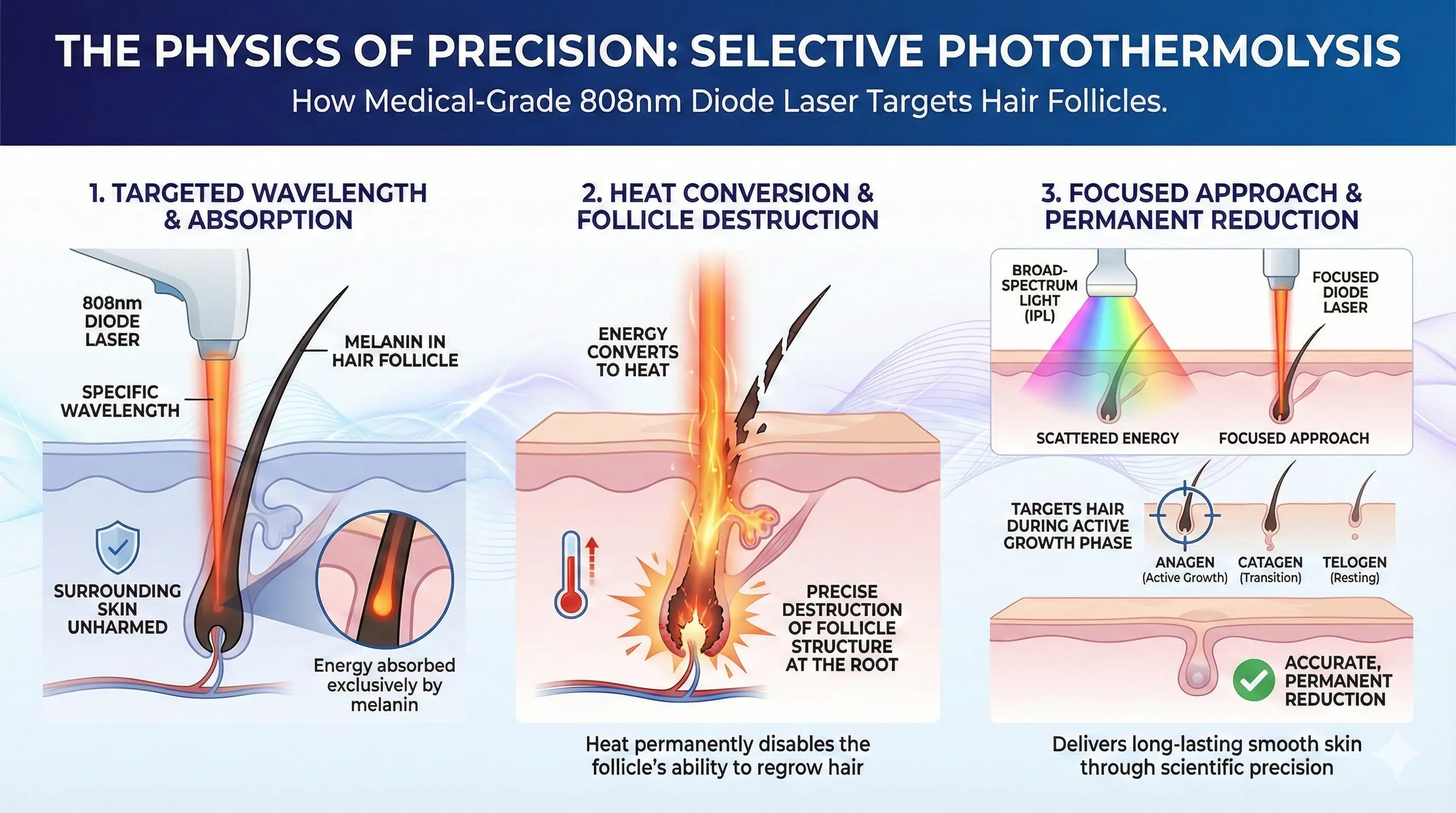
In lighter skin types, the dark hair stands out starkly against pale skin, making it an easy target. In darker, pigment-prone skin, there is a high volume of melanin in the surrounding skin tissue as well. Therefore, in darker skin, the laser may not be able to target the dark pigment inside the hair follicle, leading to inability to completely remove the hair.
- In Light Skin ──> Hits only the hair root (Safe)
- In Dark Skin ──> Hits both the hair root AND surface skin (Risk of Burns)
If a practitioner uses the wrong type of machine, the laser cannot differentiate between the melanin in your hair root and the melanin in your surface skin. It acts on both, leading to surface burns, blistering, and eventual long-term dark tracking marks.
Our skin and the Sun
Operating a laser on darker skin requires some adjustment when you live in a year-round hot, humid tropical climate like Sri Lanka. When skin is exposed to high UV indices and consistent heat, your melanocytes, the cells responsible for producing skin pigment, are already on high alert.
- High Heat & Humidity ──> Heavy Sweat ──> Friction & Irritation
- High UV Index ──> Active Melanocytes ──> REBOUND HYPERPIGMENTATION
If you undergo an aggressive laser session and step out into intense daytime sun, your skin reads the combined laser heat and UV exposure as a massive trauma. This triggers severe rebound hyperpigmentation.
Sweat and humidity also introduce the risk of bacterial infections to fresh, laser-treated follicles. If you use thick, heavy oil-based creams or traditional local soothing oils immediately after a treatment in this humidity, you will clog the vulnerable follicles, causing folliculitis, which presents as painful, pus-filled bumps that mimic a bad acne breakout and leave dark marks behind.
Finding a safe laser treatment
You must look past the flashy Instagram advertisements and low-cost packages to find a safe laser treatment.
1. Look at the laser wavelength
Before booking, ask the clinic receptionist or practitioner exactly what machine they use. If they say “IPL” or “Intense Pulsed Light” for hair removal on dark skin, walk out immediately. IPL is not a true laser; it is a broad spectrum of light that disperses across the skin surface and is highly dangerous for darker skin tones.
- The Gold Standard: A long-pulsed Nd:YAG 1064 nm laser bypasses the surface melanin entirely, diving deep down to target only the deep hair root base safely.
- The Alternative: A Diode 810 nm laser can work on intermediate skin types (Fitzpatrick Type III and IV), but it must have adjustable, long pulse durations and aggressive cooling parameters.
2. Verify practitioner certifications
A aesthetician with a two-week beauty certificate should not operate medical-grade lasers on complex skin types. Ensure the clinic is overseen by a registered medical practitioner or a qualified dermatologist who understands how to adjust the fluence (energy levels) and millisecond pulse widths to give your skin tissue time to cool down between pulses.
What to look for
This matrix outlines what parameters you must look for when choosing a certified local provider to ensure your skin barrier stays completely intact.
| Parameter | Safe | Not Recommended |
|---|---|---|
| Laser Technology | Long-Pulsed Nd:YAG (1064 nm) or advanced, cooled Diode | IPL (Intense Pulsed Light) or unbranded salon machines |
| Cooling System | Continuous cryogen spray or chilled sapphire tip | No active cooling or a simple desktop fan |
| Pre-Care Protocol | Shaving only; strictly no sun exposure for 2 weeks prior | Recent threading, waxing, or active sunburn |
| Post-Care Texture | Lightweight, non-comedogenic aloe gels or zinc lotions | Thick, heavy oils or highly fragranced fairness creams |
| Clinic Credentials | NMRA-registered medical devices operated by trained medical staff | Unregistered, cheap imported devices in a general salon |
Summary
Laser hair removal on darker skin tones is highly effective and completely safe, but only when you prioritize the correct technology over a cheap discount package. Do not hesitate to ask for a test patch on a hidden area of skin before committing to a full session to see how your tissue reacts over a 48-hour window.
Disclaimer: This article is for educational and informational purposes only and does not constitute medical advice. Always schedule a direct consultation with a certified, registered dermatologist or medical practitioner to evaluate your specific skin health before undergoing any laser procedure.